
Extracorporeal Shockwave Therapy Near Me in Bergen County, NJ
If you are searching for extracorporeal shockwave therapy near me in Bergen County, New Jersey, The Spine & Health Center offers advanced ESWT treatment at three convenient locations in Closter, Park Ridge, and Montvale. Consequently, whether you are dealing with chronic heel pain, a stubborn tendon injury, or lingering musculoskeletal discomfort that has not responded to conventional treatment, our multidisciplinary clinical team can help. Specifically, we use both focused and radial shockwave therapy to jumpstart your body’s natural healing process — without surgery, injections, or prolonged downtime. As a result, patients throughout northern New Jersey trust our clinic for non-invasive pain relief that delivers lasting results.
What Is Extracorporeal Shockwave Therapy (ESWT)?
Extracorporeal shockwave therapy is a non-invasive medical treatment that delivers high-energy acoustic pressure waves to injured or painful tissue. Specifically, the term “extracorporeal” simply means the energy originates outside the body and is directed inward through the skin using a handheld applicator. Importantly, these acoustic waves are not electrical shocks — they are mechanical pulses similar to the sound waves used in diagnostic ultrasound, but at a much higher energy level.
ESWT was originally developed in the 1980s for breaking apart kidney stones, a procedure known as lithotripsy. However, researchers soon discovered that the same acoustic energy could stimulate tissue repair in muscles, tendons, and fascia. As a result, the U.S. Food and Drug Administration (FDA) has since cleared shockwave therapy for musculoskeletal conditions such as plantar fasciitis and lateral epicondylitis. Consequently, today shockwave therapy is widely used in orthopedic, chiropractic, and physical therapy settings around the world.
At The Spine & Health Center, we integrate ESWT into our broader treatment philosophy, which aligns with evidence-based guidelines from organizations like the American Physical Therapy Association (APTA). In other words, shockwave therapy works best when combined with hands-on care, targeted rehabilitation, and a thorough understanding of the root cause behind your pain.
Conditions Treated With Shockwave Therapy
Plantar Fasciitis and Heel Pain
Plantar fasciitis is one of the most well-studied applications for shockwave therapy. Research published on PubMed (NIH) consistently shows that ESWT reduces pain and promotes structural healing in the plantar fascia. If you have been searching for shockwave therapy for plantar fasciitis near me, our Bergen County offices are equipped to treat this condition using both focused and radial protocols. In particular, patients who have tried rest, orthotics, and stretching without lasting relief often see significant improvement after a short series of sessions. Additionally, our foot and ankle specialists can evaluate your gait mechanics and recommend complementary interventions such as custom orthotics for long-term prevention.
Chronic Back Pain and Sciatica
While shockwave therapy is most commonly associated with tendon injuries, it also has applications for chronic myofascial pain in the back and hip. Specifically, patients searching for shockwave therapy for back pain near me or shockwave therapy for sciatica near me may benefit from ESWT when their pain involves tight muscle bands, trigger points, or soft tissue adhesions contributing to nerve irritation. Consequently, our chiropractors often combine shockwave with spinal adjustments and fascial manipulation to address the underlying structural issues driving chronic pain.
Tendonitis and Tendinopathy
Chronic tendon conditions — including Achilles tendinopathy, patellar tendonitis (jumper’s knee), tennis elbow, and rotator cuff tendinopathy — respond particularly well to ESWT. Notably, shockwave therapy for tendons works by stimulating the release of growth factors, promoting new blood vessel formation (neovascularization), and breaking down calcified deposits that can accumulate in chronically inflamed tendons. Therefore, for patients with shoulder pain, elbow pain, or knee pain caused by tendon dysfunction, ESWT offers a proven alternative to cortisone injections and surgery.
Sports Injuries and Athletic Recovery
Athletes at every level — from weekend runners to competitive players — benefit from ESWT as part of their sports injury recovery and performance optimization programs. For instance, shockwave therapy for sports injuries accelerates recovery from shin splints (medial tibial stress syndrome), hamstring strains, and chronic muscle tightness. Furthermore, because ESWT requires minimal downtime, athletes can typically continue training with modifications during their treatment course.
How Does Shockwave Therapy Work?
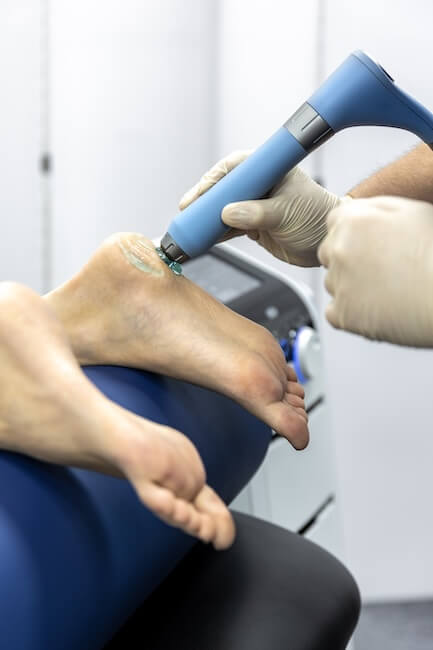
During a shockwave therapy session, your clinician applies a coupling gel to the treatment area and then uses a handheld applicator to deliver controlled acoustic waves directly to the injured tissue. As a result, these pressure waves create a cascade of biological responses that promote healing at the cellular level.
The primary mechanisms behind ESWT include increased local blood circulation and oxygen delivery to damaged tissue, stimulation of growth factors that trigger new blood vessel formation, breakdown of scar tissue and calcified deposits that restrict movement, disruption of pain-signaling nerve fibers (providing both immediate and long-term relief), and activation of stem cells that contribute to tissue regeneration. In short, shockwave therapy does not simply mask pain — it actively stimulates your body to repair the damaged structures causing it.
Focused vs. Radial Shockwave Therapy
There are two main types of shockwave therapy, and understanding the difference is important when evaluating treatment options near you.
Focused Shockwave Therapy (ESWT) delivers concentrated, high-energy waves to a precise point deep within tissue. As a result, it is ideal for treating conditions like calcific tendonitis, deep Achilles tendon injuries, and non-healing stress fractures. Focused shockwave penetrates deeper and delivers higher energy per pulse, making it the stronger option for stubborn chronic conditions.
Radial Shockwave Therapy (EPAT) disperses lower-energy pressure waves across a broader, shallower area. Consequently, it works best for superficial soft tissue problems like muscle spasms, fascial restrictions, and mild tendinopathies. EPAT is sometimes used as a first-line approach or in combination with focused shockwave for enhanced results.
At The Spine & Health Center, we offer both focused and radial shockwave therapy. Your provider will evaluate your condition, review imaging if available, and determine which modality — or combination — will produce the best outcome for your specific diagnosis.
What to Expect During Your ESWT Session
One of the greatest advantages of shockwave therapy is how straightforward and convenient each session is. Accordingly, here is what a typical appointment looks like at our Bergen County offices.
Assessment: First, your clinician will review your symptoms, examine the treatment area, and identify the precise location of pain using palpation. If you are a new patient, we will perform a comprehensive evaluation to ensure ESWT is the right fit for your condition.
Treatment: A water-based coupling gel is applied to the skin, and the shockwave applicator is pressed against the treatment area. Your provider delivers between 1,500 and 4,000 pulses per session (depending on the condition and protocol), moving the applicator in a controlled pattern over the injured tissue. Most sessions last between 5 and 15 minutes of active treatment time.
Sensation: You will feel a rhythmic tapping or pulsing sensation. Notably, some discomfort is normal — particularly over the most tender areas — but the intensity is adjustable. Your clinician will communicate with you throughout the session to keep the treatment tolerable.
After Treatment: There is no downtime, so you can walk, drive, and return to work immediately. However, your provider may recommend avoiding high-impact exercise or anti-inflammatory medications (NSAIDs) for 24 to 48 hours, because the therapeutic inflammatory response triggered by ESWT is part of the healing process.
Treatment Frequency: Most conditions require 3 to 6 sessions, spaced approximately one week apart. Subsequently, many patients begin to notice improvement within the first 2 to 3 visits, with full healing effects developing over 6 to 12 weeks.
Benefits of Shockwave Therapy
Patients throughout Bergen County choose ESWT because it offers a compelling combination of effectiveness, safety, and convenience. In particular, the key shockwave therapy benefits include the following.
Non-invasive and non-surgical. Importantly, ESWT requires no incisions, no anesthesia, and no hospital visit. It is performed in-office during a standard appointment.
No medication required. Additionally, shockwave therapy provides a drug-free pain management option, which is especially important for patients who want to avoid long-term NSAID use or opioid prescriptions.
Minimal downtime. Unlike surgery, which may require weeks or months of restricted activity, shockwave therapy allows you to resume daily activities the same day. As a result, it is an ideal option for active individuals.
Proven clinical outcomes. Multiple peer-reviewed studies — including randomized controlled trials published through the National Institutes of Health (NIH) — demonstrate that ESWT significantly reduces pain and improves function in conditions like plantar fasciitis, Achilles tendinopathy, and lateral epicondylitis.
Treats the root cause. Rather than masking symptoms, ESWT instead stimulates actual tissue repair through increased blood flow, collagen remodeling, and cellular regeneration.
Complements other therapies. ESWT integrates seamlessly with physical therapy, chiropractic care, Graston Technique, Active Release Technique (ART), and other manual therapies. In fact, research suggests that combining shockwave with rehabilitation produces better outcomes than either approach alone.
Is Shockwave Therapy Right for You?
ESWT is appropriate for most adults dealing with chronic musculoskeletal pain that has not improved with conservative care. For example, you may be a good candidate for shockwave therapy if your pain has lasted longer than 6 weeks, you have tried rest, physical therapy, or medication without lasting relief, you want to avoid surgery or cortisone injections, or you need a treatment with minimal recovery time so you can stay active.
However, shockwave therapy is not recommended for everyone. Specifically, ESWT is typically not used for patients who are pregnant, have a bleeding disorder or take blood-thinning medications, have an active infection at the treatment site, have a pacemaker or other implanted electronic device, or have a known bone tumor in the treatment area. Accordingly, your clinician will conduct a thorough screening to ensure shockwave therapy is safe and appropriate for your individual health profile.
Why Choose The Spine & Health Center for ESWT
When searching for ESWT near me or chiropractic shockwave therapy in northern New Jersey, choosing the right provider matters. Specifically, at The Spine & Health Center, our approach to shockwave therapy is defined by several key advantages.
Multidisciplinary expertise. Our clinical team includes chiropractors, physical therapists, and rehabilitation specialists who collaborate on every patient’s care plan. As a result, ESWT is never delivered in isolation — it is integrated into a comprehensive treatment strategy.
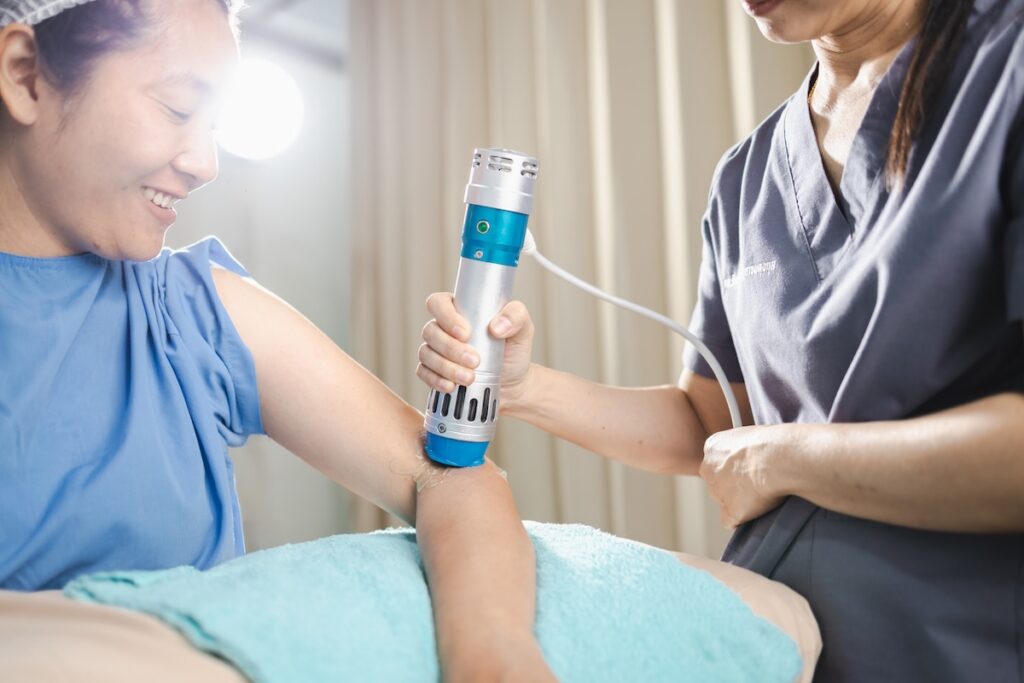
Advanced technology. We use state-of-the-art shockwave therapy systems that deliver both focused (ESWT) and radial (EPAT) protocols, giving our clinicians the flexibility to match the right technology to your specific condition.
Root-cause approach. We do not just treat symptoms. Our team uses tools like the Selective Functional Movement Assessment (SFMA) to identify the biomechanical dysfunctions contributing to your pain, then builds a treatment plan that addresses those underlying issues.
Complementary services under one roof. In addition to shockwave therapy, we offer Class IV laser therapy, acupuncture, blood flow restriction (BFR) training, NormaTec compression recovery, Trigenics, and much more. Consequently, your entire recovery plan can be managed in one place.
Three convenient Bergen County locations. With offices in Closter, Park Ridge, and Montvale, finding shockwave therapy near me in Bergen County has never been easier.
Insurance and payment flexibility. We work with a wide range of insurance providers and offer transparent pricing. Our front desk team can verify your benefits before your first appointment so there are no surprises.
Shockwave Therapy Locations in Bergen County, NJ
The Spine & Health Center of New Jersey provides extracorporeal shockwave therapy at all three of our Bergen County offices. Importantly, each location features modern treatment rooms, advanced shockwave equipment, and a welcoming clinical environment.
Closter Office
Park Ridge Office
Montvale Office
You can also book an appointment online or call us at (201) 746-6577 to get started. When you need extracorporeal shockwave therapy near me in northern New Jersey, we are here to help.
Frequently Asked Questions About Extracorporeal Shockwave Therapy
How much does extracorporeal shockwave therapy cost?
The cost of ESWT varies depending on the condition being treated and the number of sessions required. Generally, most treatment plans involve 3 to 6 sessions. At The Spine & Health Center, we work with many insurance providers and offer flexible payment options. Consequently, our team can provide a personalized cost estimate based on your treatment plan during your initial consultation.
Is shockwave therapy covered by insurance?
Insurance coverage for shockwave therapy varies by provider and diagnosis. ESWT is FDA-cleared for conditions like plantar fasciitis and lateral epicondylitis (tennis elbow), and some insurers do cover it for these approved indications. Specifically, our front desk team can verify your benefits and explain your coverage options before treatment begins. Additionally, we can discuss self-pay rates and payment plans for patients without coverage.
How many sessions of shockwave therapy do I need for plantar fasciitis?
Most patients with plantar fasciitis require 3 to 6 shockwave therapy sessions, spaced about one week apart. Notably, many patients notice improvement after the first 2 to 3 sessions. However, full healing effects may take 6 to 12 weeks to develop as the tissue regeneration process continues after your final session. Your clinician will create a personalized treatment plan based on the severity and duration of your condition.
What is the difference between focused and radial shockwave therapy?
Focused shockwave therapy (ESWT) delivers concentrated, high-energy waves to a precise point deep within tissue. In contrast, radial shockwave therapy (EPAT) disperses lower-energy pressure waves across a broader, shallower area. Focused shockwave is typically better for deep tendon injuries and calcifications, while radial shockwave works well for superficial soft tissue conditions. Importantly, The Spine & Health Center offers both types, and your provider will determine the best approach for your specific diagnosis.
Does shockwave therapy hurt?
Most patients experience mild to moderate discomfort during shockwave therapy, often described as a tapping or pulsing sensation at the treatment site. The intensity is fully adjustable, and your clinician will work with you to keep discomfort at a manageable level throughout the session. Subsequently, any soreness after treatment is typically mild and resolves within 24 to 48 hours.
What are the side effects of shockwave therapy?
Shockwave therapy is generally very safe with minimal side effects. Specifically, some patients experience temporary redness, mild swelling, or soreness at the treatment site. Fortunately, these effects typically resolve within a few days. Bruising is uncommon but possible. Above all, serious complications are rare when treatment is performed by a qualified clinician. Your provider will review any specific risks based on your health history before starting treatment.
How long does a shockwave therapy session take?
A typical session lasts between 5 and 15 minutes of active treatment time, depending on the area being treated and the protocol used. Additionally, including preparation, assessment, and post-treatment guidance, most appointments are completed within 20 to 30 minutes. Notably, there is no downtime afterward, so patients can return to normal daily activities right away.
Can I combine shockwave therapy with physical therapy or chiropractic care?
Absolutely. In fact, combining shockwave therapy with physical therapy, chiropractic adjustments, or other manual therapies often produces better outcomes than any single treatment alone. Specifically, at The Spine & Health Center, our multidisciplinary team integrates ESWT with individualized rehabilitation programs and soft tissue therapies like Graston Technique and Active Release Technique to address the root cause of your pain.
Start Your Recovery With Shockwave Therapy Today !
If chronic pain has been holding you back, extracorporeal shockwave therapy near me at The Spine & Health Center of New Jersey may be the breakthrough you have been looking for. Consequently, our experienced team is ready to evaluate your condition, explain your treatment options, and build a personalized care plan designed to get you back to the activities you love.
Book your appointment online or call (201) 746-6577 to schedule your consultation at our Closter, Park Ridge, or Montvale office today.
Related Resources
Learn more about our approach to pain relief and recovery by exploring these related pages and articles.
Shockwave Therapy Services Overview — Learn about our shockwave therapy program and treatment philosophy.
Shockwave Therapy: A Modern Solution for Chronic Pain and Recovery — Our in-depth blog post on how ESWT works and who benefits most.
Back Pain: Causes, Symptoms, Treatment & When to Seek Care — Comprehensive guide to understanding and treating back pain.
Active Release Technique (ART) — Explore this complementary soft tissue therapy often combined with ESWT.
Class IV Laser Therapy in Bergen County — Another non-invasive modality available at our offices.
Physical Therapy vs. Chiropractor — Understand how these disciplines work together in your care.
What to Expect After Spine Surgery — Learn about non-invasive recovery options for post-surgical patients.
Patient Reviews — See what our patients say about their experience at The Spine & Health Center.
Frequently Asked Questions — Browse our general FAQ page for answers to common questions about our practice.
Service Areas
We proudly serve patients seeking shockwave therapy near me from Closter, Park Ridge, Montvale, and throughout Bergen County, NJ, including Westwood, Hillsdale, Woodcliff Lake, Alpine, Englewood, Dumont, Hackensack, Oradell, River Vale, Old Tappan, Demarest, Cresskill, Northvale, and Harrington Park.