
Scoliosis Treatment in Bergen County, NJ: The Schroth Method & Non-Surgical Care
At The Spine and Health Center of New Jersey, our Schroth-certified physical therapists and chiropractors treat scoliosis and kyphosis non-surgically across our Closter, Montvale, and Park Ridge offices — for adolescents in their growth years and for adults managing curves decades later.
Scoliosis is a three-dimensional condition: the spine doesn’t just curve sideways, it rotates. That’s why generic back exercises and one-size-fits-all stretching routines rarely move the needle — and why scoliosis-specific approaches like the Schroth Method exist. Below is a complete picture of how non-surgical scoliosis treatment works, who it helps, where it has limits, and what to expect if you book an evaluation with us.
What Is the Schroth Method?
The Schroth Method is a scoliosis-specific exercise approach developed in Germany by Katharina Schroth in the 1920s and refined over a century of clinical use. It belongs to a family of techniques known as Physiotherapeutic Scoliosis-Specific Exercises (PSSE) — the most-studied conservative treatment category for scoliosis worldwide.
Unlike general physical therapy, Schroth treats scoliosis as the three-dimensional problem it is. Every exercise program is custom-built to the patient’s specific curve pattern — the direction, location, and rotation of their individual spine. The core components:
Curve-specific postural corrections:
Rotational angular breathing:
Postural awareness training:
Progressive home programming:
Scoliosis Treatment Without Surgery: When Conservative Care Is the Right First Step
Conservative scoliosis treatment is generally the right first step when:
- The curve is mild to moderate (roughly under 40-45 degrees) and skeletal growth is complete, or
- The curve is mild (10-25 degrees) in a still-growing adolescent, where scoliosis-specific exercise plus monitoring can reduce progression risk, or
- The curve is moderate (25-40 degrees) in a growing adolescent — typically managed with bracing prescribed by a physician, with Schroth exercise as the active companion to bracing, or
- An adult has a stable curve with pain, stiffness, or postural fatigue — where the goal is function and symptom control, not curve “correction.”
We coordinate with each patient’s physician or orthopedic specialist rather than replacing them. If imaging, bracing decisions, or a surgical consultation is what your case actually needs, we say so and help arrange it.
Who We Treat: Adolescents, Adults, and Everyone the System Overlooks
Adolescent Idiopathic Scoliosis (AIS)
Adult Scoliosis — the Underserved Majority
Mild Scoliosis — Worth Treating, Not Just Watching
Degenerative (De Novo) Scoliosis
How Schroth Therapy Works at Our Bergen County Offices
Your scoliosis program at The Spine and Health Center runs through three phases:
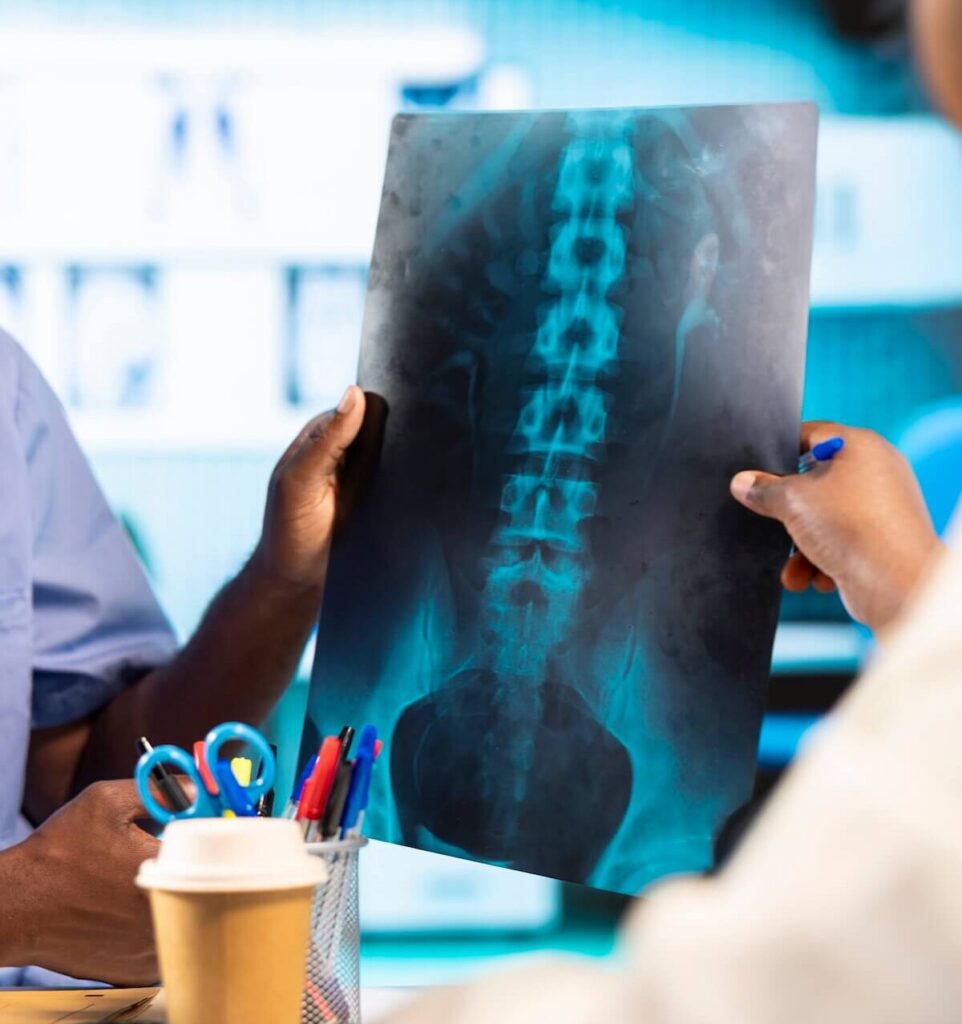
Evaluation (visit 1): a full postural and movement assessment — curve pattern classification, trunk rotation measurement, flexibility and strength testing, breathing mechanics, and a review of any imaging you bring (recent X-rays are ideal; we’ll tell you if updated imaging is worth requesting from your physician). You leave with an honest read on what conservative care can and can’t do for your specific curve.
Skill-building (the core block): one-on-one sessions with a Schroth-certified practitioner, learning your curve-specific corrections, breathing technique, and exercise set. Sessions are active — expect to work. Most patients build their full program across the initial series of visits, with technique checks and progressions after that.
Independence (the goal): Schroth’s endpoint is a patient who manages their own spine — a personalized daily program, postural habits that hold outside the clinic, and scheduled re-checks to confirm the curve is behaving. We re-evaluate on a defined schedule and tell you plainly whether the plan is working.
Our licensed physical therapists and chiropractors deliver this work with documented training in Schroth-based scoliosis-specific exercise, integrated with everything else under our roof — hands-on myofascial release for the muscular asymmetries scoliosis creates, chiropractic care where indicated, and Class IV laser therapy for pain flare management.
Can a Chiropractor Help With Scoliosis? An Honest Answer
This is one of the most-searched scoliosis questions — and the honest answer is more nuanced than most chiropractic websites admit.
What chiropractic care does NOT do: spinal adjustments do not straighten a structural scoliosis curve. No credible evidence shows manipulation alone reduces Cobb angle. Any clinic promising to “fix” scoliosis with adjustments is overselling — and yes, aggressive manipulation applied carelessly to a scoliotic spine without a scoliosis-specific plan can aggravate symptoms.
What chiropractic care DOES do well: scoliosis creates uneven loading — stiff segments, irritated joints, chronically overworked muscle on the convex side. Gentle, targeted chiropractic care reduces that pain and stiffness, improves segmental mobility, and makes the active exercise work more productive. In our model, chiropractic is a supporting tool inside a Schroth-led program — never the headline act.
That’s the distinction that matters when you search “scoliosis chiropractor near me”: you’re not looking for a chiropractor who claims to cure scoliosis. You’re looking for a practice where chiropractic, physical therapy, and scoliosis-specific exercise work as one coordinated plan. That’s what we built.
Scoliosis Exercises: What Helps — and What to Avoid
What Helps
Scoliosis Exercises to Avoid
Some loading patterns work against a scoliotic spine, especially in larger or progressing curves:
- Repeated heavy spinal flexion under load (loaded toe-touches, sit-up volume)
- Aggressive backbends and extreme extension postures held for time
- Heavy unilateral carrying that feeds the curve’s collapse pattern
- Torso-twisting sports volume in a rapidly progressing adolescent curve (case-by-case — we’d rather modify than ban)
- “One-size-fits-all” scoliosis videos that mirror exercises for both sides — your curve has a direction; exercising the wrong direction can reinforce it
This is exactly why a curve-specific evaluation comes before an exercise list. The same exercise can be corrective for one curve pattern and counterproductive for its mirror image.
Schroth Method vs. General Physical Therapy vs. Chiropractic: What's Actually Different?
General physical therapy strengthens and mobilizes — valuable, but typically symmetrical. It treats the spine as if both sides need the same thing. For scoliosis, they don’t.
The Schroth Method is asymmetrical by design. Every position, breath, and resistance direction is chosen to unload the concave side, activate the convex side, and de-rotate the trunk. It’s the difference between general fitness for a spine and a program engineered against your specific curve.
Chiropractic adjustments mobilize stiff segments and reduce pain — a complement, not a correction (see H2 #5).
Bracing (for growing adolescents with moderate curves) is prescribed by physicians, not by us — and when a brace is part of your child’s plan, Schroth exercise is its natural partner: the brace holds correction passively while Schroth builds the muscle and awareness to hold it actively.
Most patients at our Bergen County offices end up with a blend: Schroth as the spine of the program (literally), with PT, chiropractic, and soft-tissue work — like myofascial release — supporting it.
Kyphosis Treatment: The Other Curve We Treat
Kyphosis — excessive forward rounding of the upper back — responds to the same family of scoliosis-specific principles: postural re-training, targeted extension strengthening, breathing mechanics, and flexibility work for the chest and hip flexors. We treat postural kyphosis (the reversible kind that develops from years of desk posture), Scheuermann’s-related rounding in adolescents, and age-related kyphosis in adults where the goals are posture endurance, pain reduction, and protecting breathing capacity.
If your “scoliosis” is actually a kyphosis — or both — the evaluation sorts that out and the program is built accordingly. Patients with neck and shoulder symptoms from forward-head posture often pair this work with our head and neck pain care.
What to Expect at Your First Scoliosis Evaluation
-
History When the curve was identified, imaging history, bracing history, symptoms, sports and activity goals, and — for adolescents — growth indicators.
-
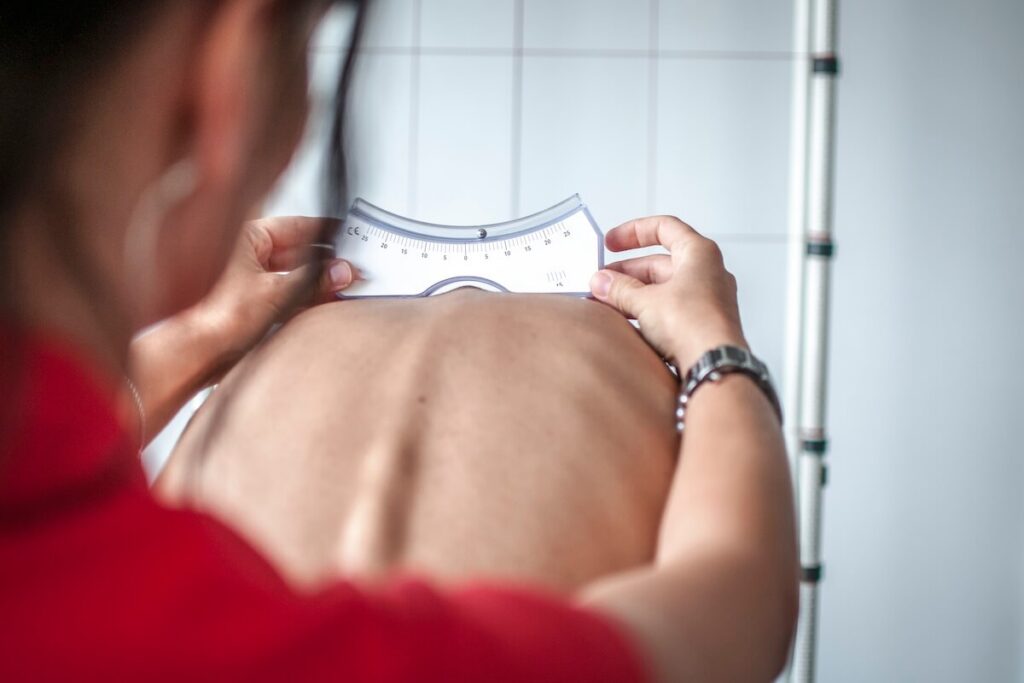
Postural assessment Visual and measured analysis of trunk symmetry, shoulder and pelvic alignment, rib prominence (including a forward-bend assessment), and rotation.
-
Movement and strength testing Flexibility, core endurance, breathing pattern, and how your curve behaves under correction — the single most useful predictor of how exercise-responsive a curve will be.
-
Plan and straight talk What conservative care can realistically achieve for this curve, what schedule it takes, what we'd monitor, and whether anything in the picture warrants a physician or specialist referral first.
How Long Does Schroth Treatment Take?
An honest answer, because the internet is full of vague ones:
- Skill-building phase: most patients need an initial series of one-on-one sessions over several weeks to learn their corrections properly. Schroth is a skill, like learning a golf swing — repetitions with feedback matter early.
- Daily home program: 15-30 minutes most days. This is where results actually come from; the clinic visits exist to build and progress it.
- Re-evaluation rhythm: scheduled re-checks — and for growing adolescents, coordination with their physician’s imaging schedule — confirm the curve is stable or improving.
- Duration honesty: adolescents typically continue some version of their program through their growth years. Adults usually transition to a maintenance routine once symptoms and posture goals are met. Anyone promising a fixed number of sessions to a guaranteed degree change isn’t being straight with you.
We re-assess on a defined schedule, measure against the goals set at evaluation, and tell you plainly if progress has stalled and the plan needs to change.
Where Non-Surgical Scoliosis Care Has Limits
Conservative care is the right first step for most curves. It is not the right only step for all of them. We refer for physician or surgical evaluation when:
- An adolescent’s curve progresses past the moderate range despite bracing and exercise, or presents already large (typically 45-50+ degrees while still growing)
- An adult curve is accompanied by progressive neurological signs, worsening leg weakness, spreading numbness, or bowel/bladder changes (the last one is an urgent ER evaluation, not an appointment)
- Pain or walking limits keep worsening despite a properly executed conservative program
- Imaging shows a curve pattern or progression rate that scoliosis-specific exercise was never designed to hold
Curves in these categories deserve a spine specialist’s opinion, and conservative care often still plays a role before and after surgery (pre-operative conditioning and post-surgical rehabilitation are both things we support). The point of this page isn’t “never surgery.” It’s that surgery, when it’s needed, should be a deliberate decision, not the only option you were ever shown.
Schedule a Scoliosis Evaluation in Bergen County
Whether it’s your child’s new diagnosis, a curve you’ve carried since high school, or signs and symptoms of scoliosis you’ve noticed yourself — like uneven shoulders, a visible curve in the spine, or a posture change in the mirror — the right first step is a proper evaluation by practitioners certified in scoliosis-specific care. Call any of our Bergen County offices in Closter, Montvale, or Park Ridge, or book online. Same-week appointments are typically available.