Myofascial Release Therapy in Bergen County, NJ — Hands-On Care for Stubborn Pain
What is myofascial release?
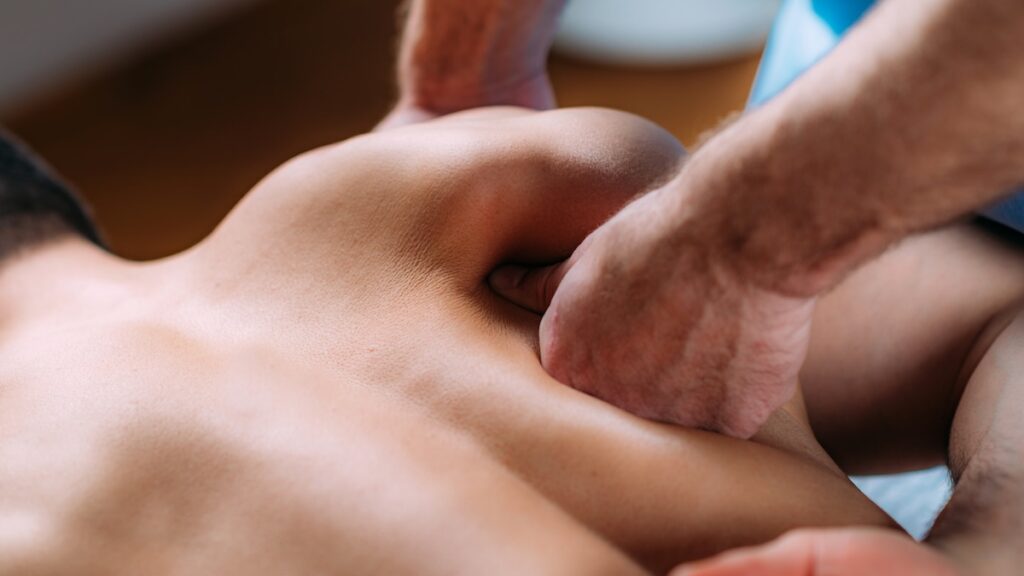
Myofascial release (MFR) is a manual therapy that uses sustained, gentle pressure to release tightness and restrictions in the fascia — a continuous web of connective tissue that wraps and connects every muscle, bone, nerve, blood vessel, and organ in the body.
Healthy fascia is fluid and elastic. When fascia is healthy, you move easily. After trauma, repetitive strain, inflammation, surgery, or prolonged poor posture, fascia can become dehydrated, sticky, and rigid. Those restrictions can produce up to roughly 2,000 pounds per square inch of pressure on pain-sensitive structures — which is why fascial tightness can refer pain far from the original site of injury.
MFR addresses this directly. A clinician applies steady pressure to a restricted area for 90 to 120 seconds — long enough for the fascia to soften and reorganize. Unlike massage, the technique doesn’t glide across the skin; the clinician’s hands stay in one spot and wait for the tissue to release.
The treatment can be delivered as direct MFR (firmer pressure, faster release) or sustained-pressure MFR following the John Barnes approach (lighter, slower, often longer holds). Most Bergen County patients respond well to a combination of both, adjusted to the tissue’s behavior on the table.
Myofascial release is NOT just a massage
If you’ve come in expecting a 60-minute relaxation massage, myofascial release will feel different — and that’s intentional.
A massage focuses on muscle: gliding strokes, kneading, and warming the tissue to reduce tone and increase circulation. The therapist moves continuously across the body.
Myofascial release focuses on fascia: a clinician identifies a restricted band of tissue, applies low-load sustained pressure, and waits — often for two minutes or longer — until the fascia softens under their hands. You may stay in one position for the bulk of the session.
The result is different too. Massage typically leaves you relaxed and slightly heavy. MFR often leaves you feeling looser and taller — with a noticeable change in your range of motion in the area treated. Patients sometimes describe it as “something finally let go.”
This distinction matters because the wrong expectation gets in the way of results. If you book a relaxation massage when what you need is fascial release, you may leave temporarily relaxed but with the underlying restriction untouched. Telling your clinician what you’ve already tried lets us match the right hands-on therapy to your case from the first visit.
Conditions myofascial release helps most
Chronic Low Back Pain
Lumbar fascial restriction is one of the most common drivers of chronic low back pain that imaging can’t explain. When the thoracolumbar fascia tightens after repeated lifting, prolonged sitting, or an old injury, it can pull on the lumbar spine and create a dull, persistent ache that nothing seems to help. MFR targeted to the thoracolumbar fascia, glutes, and quadratus lumborum is often the relief patients have been looking for. See our full guide to back pain for a broader treatment overview.
Neck Pain and Tension Headaches
Tight fascia in the upper trapezius, suboccipitals, and scalene muscles can refer pain into the base of the skull, the temples, behind the eyes, or down into the shoulder. Patients who have tried every neck stretch on the internet and still wake up tight often respond quickly to MFR in this region. Combined with chiropractic adjustment when indicated, the change can hold for weeks rather than hours. More detail in our head and neck pain overview.
Sciatica and Piriformis Syndrome
The sciatic nerve runs directly through or under the piriformis muscle, deep in the buttock. When the piriformis and surrounding gluteal fascia tighten, they can compress the nerve and refer burning, electric, or numbing pain down the leg — mimicking a disc problem on imaging that’s actually a soft-tissue issue. MFR to the piriformis, deep gluteals, and surrounding fascia is one of the highest-leverage interventions for this pattern. See our complete sciatica treatment guide for related conditions.
TMJ and Jaw Pain
The fascia around the jaw, neck, and upper shoulders connects directly to the muscles of mastication. Sustained MFR to the masseter, pterygoid, and surrounding cervical fascia can reduce jaw tension, clicking, and the headaches that ride along with TMJ. It’s one of the few hands-on options for TMJ patients who don’t want a bite splint as a first-line treatment.
Frozen Shoulder and Rotator Cuff Restriction
Hip and Pelvic Floor Pain
Plantar Fasciitis and Foot Pain
Fibromyalgia and Widespread Soft-Tissue Pain
Myofascial release vs other hands-on therapies
| Therapy | What makes it different |
|---|---|
| Myofascial Release (MFR) | Light-to-moderate, sustained pressure held in one spot for 90+ seconds. The clinician stays still and lets the fascia release. Targets the connective-tissue sheet, not the muscle belly. |
| Deep Tissue Massage | Heavy, gliding pressure that moves through muscle bellies and trigger points. Often wins for post-workout muscle tension; loses for chronic fascial restriction that doesn’t change with massage no matter how deep. |
| Swedish / Therapeutic Massage | Long, soothing strokes — a relaxation modality. Excellent for stress reduction. Does not produce sustained changes in fascial restriction. Different goal, different tool. |
| Trigger Point Therapy | Focused pressure (30–60 seconds) on tight knots within muscle to reproduce and release referred pain. Narrower than MFR — point-tender areas only. The two are highly compatible and often combined. |
| Active Release Technique (ART) | Pinning of soft tissue while the patient moves the joint through range — manual pressure plus active movement. Excellent for sports injuries and adhesions between muscle layers. MFR is largely passive. |
| Graston / IASTM | Stainless steel instruments scraped across fascial restrictions and scar tissue. Often more effective for dense scar tissue and chronic tendinopathy. MFR is hands-only — gentler, better tolerated for fibromyalgia, sensory-sensitive, and elderly patients. |
| Craniosacral Therapy | Very light, sustained pressure focused on the cranial bones, sacrum, and cerebrospinal fluid rhythm. Overlaps technically with MFR but operates from a different theoretical model. Our practice uses MFR as the primary fascial intervention. |
What a myofascial release session looks like
A new patient visit starts with a 20 to 30 minute clinical history — what brought you in, what’s been tried, what worsens or relieves the pain, your work and movement patterns. We then perform a postural and movement assessment to identify likely fascial restriction patterns.
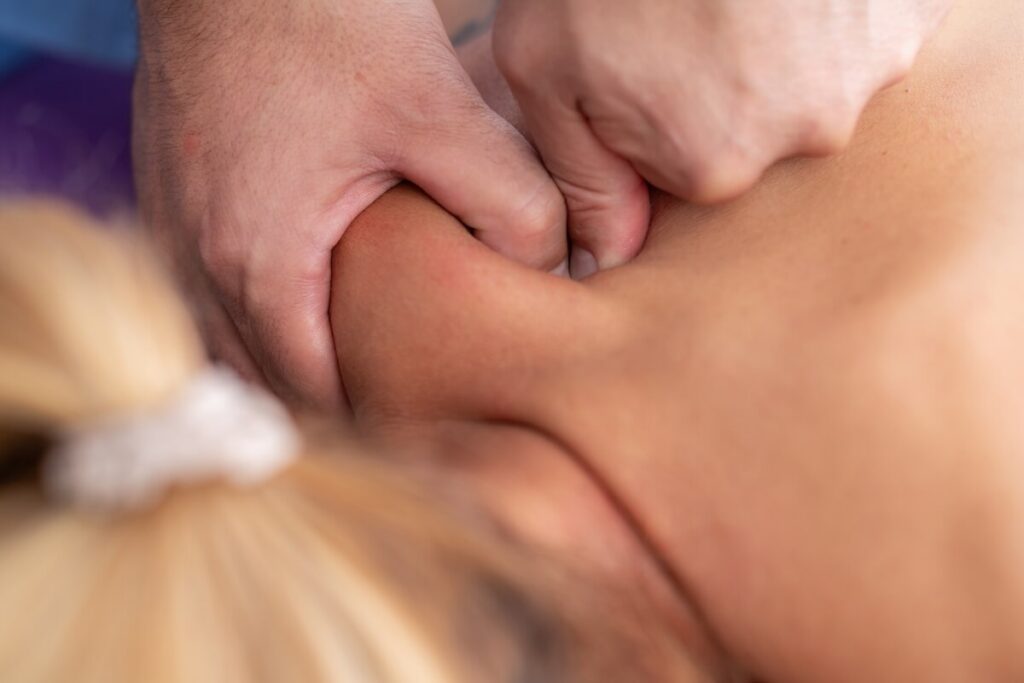
The hands-on portion of the session typically runs 30 to 45 minutes. You’ll be on a treatment table, partially draped, in a quiet room. The clinician palpates for fascial restrictions, applies sustained pressure for 90 to 120 seconds per area, waits for the tissue to release, and moves to the next restriction. You may stay in one or two positions for most of the session.
You’ll be asked for feedback throughout — pressure, sensation, any referred pain that surfaces. The technique is highly adjustable. We can go lighter for fibromyalgia and sensory-sensitive patients, deeper for athletes and patients with denser tissue.
At the end of the session, the clinician typically prescribes 2 to 3 self-care movements or self-myofascial release tools to use between visits.
How many sessions will I need?
- Acute fascial restriction (under 6 weeks): often resolves in 3-5 sessions.
- Subacute restriction (6 weeks to 6 months): typically 6-10 sessions, often combined with corrective exercise.
- Chronic restriction (6+ months, including post-surgical scar tissue or long-standing pain patterns): often 10-15 sessions across 2-3 months, with maintenance sessions thereafter.
We re-evaluate every 4-6 sessions. If you’re not seeing measurable progress — pain reduction, range-of-motion gains, functional improvement — we say so, and we adjust the plan or refer out. We don’t run open-ended care plans.
What to Expect During and After a Session
During the session, you may feel pressure that builds and then suddenly softens — that’s the fascia releasing. You may feel referred sensations: warmth, tingling, a wave of relaxation, or occasionally a brief emotional response (this is common with deep fascial work and not a sign of harm). Patients often comment that they feel “taller” or “lighter” within the first 10 minutes.
After the session, the most common experience is improved range of motion, reduced pain, and feeling looser through the treated region. Some patients feel mildly sore for 24-48 hours — similar to post-workout soreness — particularly after the first session.
A small subset of patients feel temporarily worse after the first MFR session — increased fatigue, mild flu-like symptoms, or a flare in the original pain pattern. This is called a “fascial detox response” or “treatment reaction,” and it usually resolves within 24-48 hours. Hydration, light movement, and rest help. If you’ve experienced this with bodywork before, tell us at the start so we can dial in pressure and pacing to minimize it.
Persistent worsening beyond 48 hours is uncommon and should be reported. It typically means the pressure was too aggressive for your tissue or that there’s an underlying issue we need to re-evaluate.
Who Should NOT Have Myofascial Release?
MFR is generally very safe — among the lowest-risk hands-on therapies — but it’s not appropriate in every situation. We screen for the following before treatment:
- Active deep vein thrombosis (DVT) or known clotting disorder
- Acute fracture or recent surgery (within 6-8 weeks, depending on the procedure)
- Active infection or inflammatory skin condition in the area to be treated
- Uncontrolled bleeding disorders or current anticoagulation requiring physician clearance
- Active cancer in the treatment region (we coordinate with the patient’s oncology team)
Severe osteoporosis (pressure is significantly modified; some regions are avoided) - Pregnancy (MFR is generally safe with modifications; we follow standard pregnancy-care protocols)
This list isn’t exhaustive. Bring a current medication list and a brief medical history to your first visit — we’ll review it before any hands-on work begins.

Self-Myofascial Release at Home
What you do between sessions matters as much as what we do on the table. Self-myofascial release with a foam roller, lacrosse ball, or massage tool extends the gains from clinical MFR and prevents fascial restriction from re-accumulating.
The principles are the same as clinical MFR: sustained, moderate pressure (not aggressive grinding), held for 60-120 seconds per area, while you breathe and let the tissue soften. The mistake most people make is rolling fast and hard — that’s not MFR, it’s just irritation.
- High-density foam roller for thoracolumbar fascia, quads, IT band, and glutes
- Lacrosse ball or tennis ball for piriformis, suboccipital release, and pectoralis minor
- Small massage ball for foot and plantar fascia release
- 2-3 specific self-MFR positions matched to your case
We send patients home with a written or video reference for the techniques most relevant to their pattern.
Does Myofascial Release Actually Work? — An Honest Look
In our experience treating Bergen County patients, MFR produces consistent, measurable results for:
- Chronic non-specific low back and neck pain
- Sciatica with a piriformis or gluteal fascial component
- TMJ tension and tension-type headaches
- Frozen shoulder (as part of a combined approach)
- Plantar fasciitis when the calf and posterior chain are also treated
- Fibromyalgia (light pressure, slow pacing)
- Acupuncture for post-operative scar tissue, used alongside MFR to soften adhesions and restore tissue mobility
MFR is not a cure-all and shouldn’t be sold as one. It generally does not resolve:
- Structural disc herniation with frank nerve compression (decompression or surgical consultation is usually indicated — see our spinal decompression therapy page)
- Spinal stenosis with neurogenic claudication (mechanical not soft-tissue — see our spinal stenosis treatment page)
- Acute inflammatory arthritis flare (anti-inflammatory medical care first)
- Pain driven by an undiagnosed metabolic or systemic illness
- Severe motor or sensory deficits (need urgent medical workup, not bodywork)
If MFR is the wrong tool for your case, we say so and refer to the right provider — orthopedic specialist, neurologist, primary care, or surgical consultation. Hands-on therapy is part of a thoughtful plan, not a substitute for a real diagnosis.
Why Choose The Spine and Health Center for Myofascial Release
Our practice has delivered myofascial release as part of integrated chiropractic and physical therapy care across Bergen County for over a decade. Three things shape how we work:
First, our licensed chiropractors and Doctors of Physical Therapy each have documented training in hands-on fascial techniques — including both direct and sustained-pressure (John Barnes-style) approaches — applied within evidence-informed treatment plans.
Second, MFR is never our only tool. Patients who need joint mobilization, decompression, instrument-assisted work (Graston / IASTM), or Active Release Technique get all of it — sequenced by what their tissue actually needs visit-to-visit. We don’t deliver isolated MFR when a combined approach gives faster results.
Third, we re-evaluate every 4-6 sessions and tell you honestly whether the care plan is working. If MFR is the right tool for your case, you’ll know within the first 3-5 visits. If it isn’t, we change the plan or refer.
Same-week availability across our Closter, Montvale, and Park Ridge offices. Convenient access for patients across Bergen County including Bergenfield, Englewood Cliffs, Fort Lee, Hackensack, and the surrounding area.