
Class IV & Deep Tissue Laser Therapy in Bergen County, NJ
What is Class IV laser therapy?
Class IV laser therapy is a high-power therapeutic laser treatment that delivers focused infrared light energy deep into tissue to relieve pain, reduce inflammation, and accelerate healing. The “Class IV” designation is an FDA classification — it refers to the laser’s output power (greater than 500 milliwatts), which determines how deeply the light can penetrate the body. Class IV lasers can reach injured tissue 3 to 5 centimeters below the skin, making them effective for conditions that lower-power “cold lasers” (Class III or below) cannot reach.
The mechanism is photobiomodulation: photons of specific infrared wavelengths are absorbed by cells in the targeted tissue, triggering increased mitochondrial activity, improved oxygenation, reduced oxidative stress, and faster cellular repair. The patient feels a gentle warmth as the laser is moved over the treatment area; the session typically lasts 5 to 10 minutes per region, with no pain, no recovery time, and no medication required.
Class IV laser therapy is FDA-cleared, supported by peer-reviewed research, and used by professional sports teams, hospital pain-management programs, and integrated chiropractic and physical therapy practices worldwide. At The Spine and Health Center of New Jersey, it is one tool inside a broader treatment plan — most commonly combined with chiropractic adjustment, physical therapy, spinal decompression, or myofascial release depending on the diagnosis.
Therapeutic lasers are classified by output power:
- Class I and II: laser pointers and scanners — no therapeutic application.
- Class IIIa (5 mW or less) and Class IIIb (500 mW or less): “cold lasers” or low-level laser therapy (LLLT) — limited penetration depth, longer session times, typically used for surface tissue and acupuncture-point stimulation.
- Class IV (greater than 500 mW): high-power therapeutic lasers, often called “deep tissue laser therapy” or “high-intensity laser therapy” (HILT) — capable of reaching deeper tissue layers, shorter session times, broader clinical use.
Class IV is the category currently used in most evidence-based chiropractic and physical therapy practices for musculoskeletal pain. It is the same general class of laser used by major orthopedic clinics, sports medicine programs, and pain-management centers.
Class IV laser therapy is NOT cosmetic laser resurfacing
This is the single most common point of confusion patients run into when researching Class IV laser therapy. Worth clearing up before going further.
Class IV therapeutic laser is a medical treatment for musculoskeletal pain, inflammation, and tissue healing. It is delivered by a chiropractor, physical therapist, or pain-management physician. The laser does not break the skin, does not produce a visible burn, and is not used to alter the appearance of skin or hair. There is no recovery time and no scabbing — patients walk out of the session and return to normal activity immediately.
Cosmetic laser resurfacing — sometimes searched as “laser skin resurfacing” or “laser facial” — is a completely different procedure. It is delivered by a dermatologist or cosmetic surgeon using ablative or fractional CO2 / Erbium lasers that vaporize the outer skin layers to reduce wrinkles, scars, or pigmentation. It involves recovery time, skincare protocols, and visible “downtime” of skin healing. It does not treat musculoskeletal pain.
Both are sometimes called “laser therapy” because both use focused light energy — but the wavelengths, power densities, target tissue, training pathways, and clinical goals are entirely different. The Spine and Health Center of New Jersey provides Class IV therapeutic laser for medical conditions such as back pain, neuropathy, sciatica, and joint pain. We do not offer cosmetic laser services. If you are looking for cosmetic laser resurfacing, your search should point you toward a dermatology or medical spa practice.
How Class IV laser therapy works
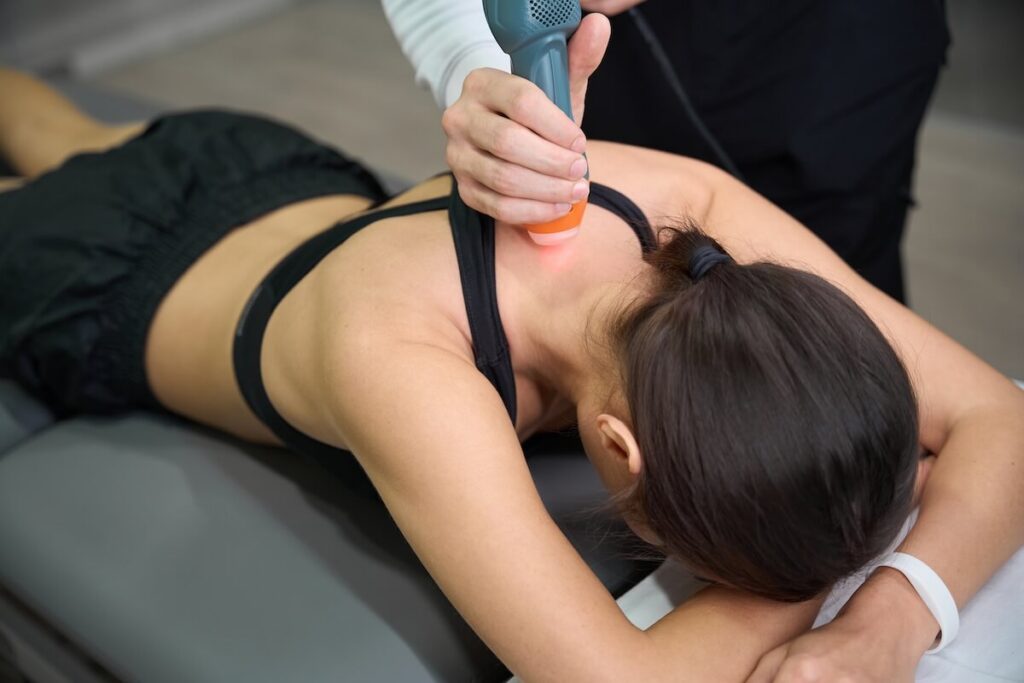
A Class IV laser therapy session begins with the clinician identifying the target tissue based on your diagnosis — typically a specific muscle, joint, tendon, or peripheral nerve. Protective glasses are placed on both the patient and the clinician to shield against the laser light. The clinician then moves a handheld laser applicator over the treatment area in slow, controlled passes for 5 to 10 minutes per region.
The laser emits focused infrared light at therapeutic wavelengths (typically in the 800 to 980 nanometer range — the “biological window” where light penetrates tissue most efficiently and is absorbed by mitochondrial cytochromes). The energy is calibrated to your specific condition, body composition, and treatment area. The patient feels a gentle, deep warmth — never a burning or sharp sensation. Most patients find the experience relaxing; some fall asleep during sessions.
What happens at the cellular level
When Class IV laser light is absorbed by cells in the targeted tissue, three primary biological effects occur.
Photobiomodulation: Mitochondrial cytochrome c oxidase absorbs the infrared photons and increases adenosine triphosphate (ATP) production. ATP is the cellular energy currency required for repair, regeneration, and inflammation control. Tissue that was metabolically sluggish becomes metabolically active.
Increased microcirculation: The laser stimulates nitric oxide release, which dilates blood vessels in the treated area. More blood means more oxygen, more nutrients, more immune cells, and faster clearance of inflammatory waste products. Bruising and swelling resolve faster.
Modulation of inflammatory mediators: The laser shifts the local inflammatory environment from chronic pro-inflammatory signaling (which perpetuates pain) toward resolution-phase signaling (which clears inflammation and allows healing to proceed). For chronic conditions where inflammation has been “stuck” in pro-inflammatory mode for weeks or months, this is often the unlock that finally allows tissue to start healing.
The result: a treatment that addresses the cellular biology of injury and inflammation, not just the symptom of pain. This is why Class IV laser is most effective when used as part of a broader treatment plan — it accelerates the healing the body is already trying to do.
Class IV vs cold laser vs deep tissue vs HILT: what's the difference?
Class IV laser therapy vs. Class III cold laser therapy (LLLT)
Class IV laser therapy vs. deep tissue laser therapy
Class IV laser therapy vs. high-intensity laser therapy (HILT)
Class IV laser therapy vs. red light therapy
Class IV laser therapy vs. cosmetic laser resurfacing
Conditions treated with Class IV laser therapy
Chronic and acute back pain
Both acute (recent onset) and chronic (more than 12 weeks) lower-back pain respond to Class IV laser therapy. The laser penetrates through the dense paraspinal muscle layer to reach deep tissue, including the supraspinous and interspinous ligaments, multifidus muscles, and posterior facet joints — areas where surface heat, ultrasound, and TENS cannot reliably reach. Most often combined with chiropractic adjustment, spinal decompression, or physical therapy. See our back pain page for the full treatment framework.
Sciatica and radiating leg pain
Class IV laser is used as an adjunct to mechanical treatments for sciatica — the laser reduces inflammation around the sciatic nerve roots (most commonly L4, L5, and S1) and accelerates recovery between sessions. It works particularly well for sciatica patients who have stalled out on stretching, chiropractic adjustment, or oral anti-inflammatories alone. See our complete sciatica treatment guide.
Peripheral neuropathy and diabetic neuropathy
Knee pain (osteoarthritis, tendinitis, post-surgical recovery)
The knee is one of the highest-volume Class IV laser indications. The joint sits close to the skin (less tissue to penetrate) and contains multiple tendon, ligament, and synovial structures that respond well to photobiomodulation. Used for knee osteoarthritis, patellar tendinitis, IT band friction, MCL or LCL strain, and post-arthroscopic knee surgery rehabilitation. See our knee pain page.
Shoulder pain (rotator cuff, frozen shoulder, impingement)
Rotator cuff tendinopathy, subacromial impingement, and adhesive capsulitis (frozen shoulder) all respond to Class IV laser — typically combined with manual mobilization and targeted exercise. The laser reaches the supraspinatus, infraspinatus, and subscapularis tendons through the deltoid musculature. Particularly effective for shoulder pain that has been ongoing for more than 6 weeks. See our shoulder pain page.
Hip pain and gluteal tendinopathy
Greater trochanteric pain syndrome, gluteal tendinopathy, hip flexor strain, and piriformis syndrome — common causes of hip pain — all respond to Class IV laser. The deeper hip musculature (gluteus medius, deep external rotators, iliopsoas) is exactly the layer that Class IV reaches and lower-power lasers cannot. See our hip pain page.
Plantar fasciitis and foot pain
The plantar fascia, Achilles tendon, and peroneal tendons all respond to Class IV laser. Plantar fasciitis is one of the highest-evidence indications — multiple studies show meaningful improvement in heel pain and morning stiffness within 4 to 8 sessions when combined with stretching and supportive footwear modifications.
Tennis elbow, golfer's elbow, and other tendinopathies
Sports injuries and post-surgical recovery
Acute sprains, muscle strains, post-injury inflammation, and post-surgical scar tissue recovery during the rehabilitation phase after orthopedic surgery (with surgical clearance) — Class IV laser accelerates the natural healing process and shortens return-to-sport timelines.
Headaches and TMJ-related pain
Cervicogenic headaches and TMJ-related jaw pain — when driven by muscle tension or temporomandibular joint inflammation — respond to Class IV laser when paired with manual therapy. See our head and neck pain page.
What to expect during a Class IV laser therapy session
Preparation (1 to 2 minutes)
Treatment (5 to 10 minutes per region)
Post-treatment (1 to 2 minutes)
Between sessions
Does Class IV laser therapy actually work? Evidence and results
What the research shows
What we see clinically
What patients commonly report
Where laser does not help
How many Class IV laser sessions will you need?
Acute soft tissue injury (less than 6 weeks)
Two sessions per week for 2 to 3 weeks. Most acute cases complete in 4 to 6 sessions.
Sub-acute or recurrent injury (6 weeks to 6 months)
Two sessions per week for 3 to 5 weeks. Most cases complete in 6 to 10 sessions.
Chronic condition (greater than 6 months)
Two sessions per week for the first 3 to 4 weeks, then re-assessment. Chronic conditions typically require 10 to 15 sessions across 6 to 8 weeks; some respond faster, some take a full 20-session course.
Peripheral neuropathy
Trial of 6 to 8 sessions before a longer-course commitment. Neuropathy responders typically continue for 18 to 24 sessions across 10 to 14 weeks for sustained benefit.
Maintenance after active treatment
Many patients transition to a maintenance phase of one session every 4 to 8 weeks, particularly patients with chronic tendinopathies, recurring joint pain, or physically demanding occupations.
A single Class IV laser session — including setup and review — lasts 10 to 20 minutes depending on how many regions are treated. The laser delivery itself is 5 to 10 minutes per region. The minimum effective dose: laser produces a cellular signal that requires consistent repetition over weeks to drive structural change — one session per month is not enough to drive improvement during active treatment. Twice per week during the acute phase is the standard.
Side effects, safety, and contraindications
Common normal experience
Side effects to call your provider about
Contraindications — patients we will not treat with Class IV laser
Eye safety
Pros and cons of Class IV laser therapy
Pros — what Class IV laser does well
Cons — where Class IV laser falls short
Not a stand-alone cure — works best as an adjunct, not a sole treatment. Cannot reverse advanced structural damage (severe joint degeneration with bone-on-bone arthritis, large rotator cuff tears, complete tendon ruptures). The effect is incremental — patients expecting a one-session fix will be disappointed. Requires a 6 to 10 session minimum to evaluate response in most cases; a “single trial session” is not a meaningful test. Some chiropractic clinics market Class IV laser aggressively as a stand-alone solution to almost any condition — that is overselling, and patients should be wary of clinics making that promise. The honest answer is that laser is a strong cellular-level tool that accelerates the healing your body is trying to do — when paired with the right manual care, exercise, and structural treatment for your specific case.
Honest takeaway
Class IV laser is one of the most useful tools in modern non-surgical musculoskeletal care when applied to the right conditions in the right patients. For appropriate cases — chronic tendinopathies, plantar fasciitis, knee osteoarthritis, sciatica, neuropathy, sports injury recovery, and the recovery phase after surgery — laser can be the unlock that moves a stalled case forward. For patients with advanced structural damage that requires surgical correction, or for patients expecting a one-session miracle, laser is not the right tool. We tell patients honestly which category they fall into during the consultation.
Why choose The Spine and Health Center of New Jersey for Class IV laser therapy
Our laser-trained clinical team
Class IV laser therapy at The Spine and Health Center of New Jersey is delivered by our licensed chiropractors and Doctors of Physical Therapy — each with documented training in therapeutic laser application and supervised clinical experience treating the conditions covered on this page. We maintain a multi-disciplinary team across all three Bergen County offices, so patients have continuity of care regardless of which location, day, or provider they see.
You can meet our full clinical team, where each provider’s training, certifications, and specialty focus are documented.
What sets our practice apart
Integrated care under one roof. Class IV laser is rarely a stand-alone treatment in our practice — it is typically combined with chiropractic adjustment, spinal decompression, physical therapy, Graston technique, or myofascial release on a single coordinated plan. This is the right way to use laser — as the cellular accelerator inside a broader treatment strategy.
Evidence-based dosing protocols. The clinical effectiveness of Class IV laser depends entirely on dose — the right wavelength, the right power density, the right time, the right number of sessions. Underdosing produces no result; overdosing produces no additional benefit and wastes the patient’s time. Our protocols follow current published research and manufacturer guidance, not marketing claims.
Honest pre-treatment assessment. If Class IV laser is not the right tool for your condition, we tell you and refer appropriately. We do not push laser packages to patients we do not believe will benefit.
Convenient Bergen County access. Three locations — Closter, Park Ridge, and Montvale — each with weekday hours and Saturday availability at the Closter office. Patients from Englewood Cliffs, Fort Lee, Hackensack, Westwood, and across the NJ-NY metro area regularly travel to our offices for laser care.
Most major insurance accepted. We verify your specific coverage before your first session so you know what to expect on the billing side.
Schedule a Class IV laser therapy consultation
Closter Office
Park Ridge Office
Montvale Office
What to bring to your first appointment
Frequently Asked Questions
How long does it take for Class IV laser therapy to work?
Can Class IV laser therapy be combined with other treatments?
Yes — and it usually should be. Class IV laser works best as part of an integrated treatment plan, not as a stand-alone solution. Laser is most commonly combined with chiropractic adjustment, physical therapy, spinal decompression, Graston technique, or myofascial release in the same visit or treatment series. The laser is typically delivered first to “prime” the tissue, followed by manual work or rehabilitation exercise.
Does Class IV laser therapy hurt?
How is Class IV laser different from cold laser therapy?
Is Class IV laser therapy the same as cosmetic laser resurfacing?
Can Class IV laser therapy cause damage?
Can Class IV laser help with peripheral neuropathy?
How many Class IV laser sessions will I need?
What is the difference between Class IV laser, deep tissue laser, and HILT?
Who performs Class IV laser therapy at The Spine & Health Center?
Class IV laser is performed by our licensed chiropractors and Doctors of Physical Therapy across all three Bergen County locations — Closter, Montvale, and Park Ridge. Each clinician has documented training in therapeutic laser application and supervised clinical experience treating the conditions on this page. The front desk will match you with the right provider when you book. (See our full team.)