
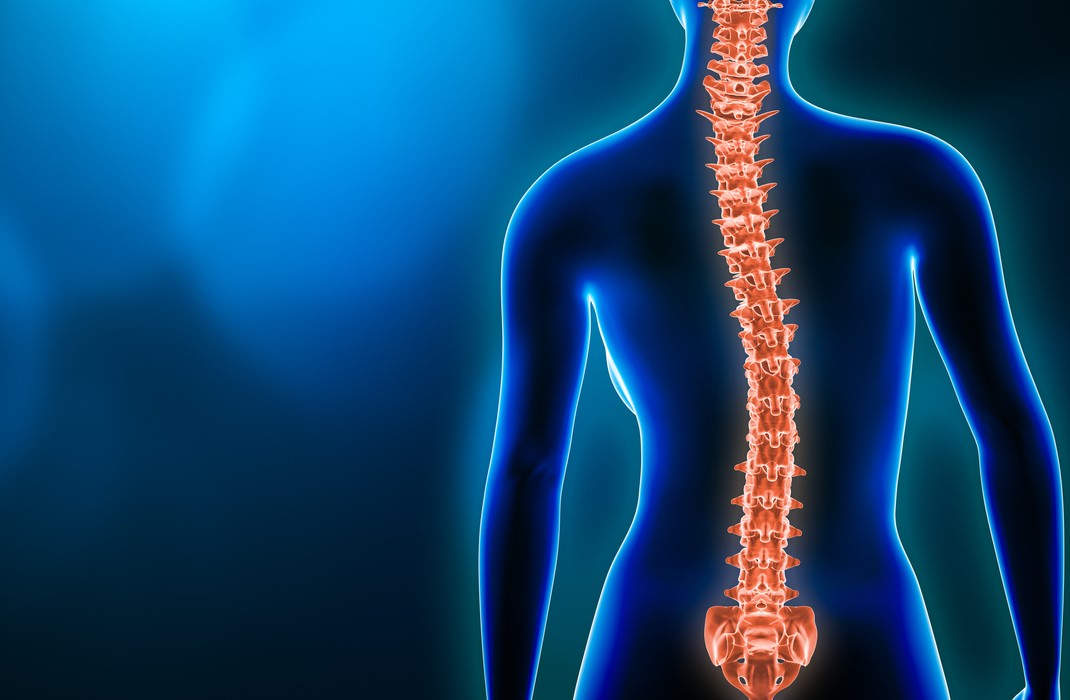
What is scoliosis, really?
New U.S. diagnoses per year
Of the population is affected
Girls more likely to need treatment than boys
The most common type — adolescent idiopathic scoliosis — develops during the growth spurt between ages 10 and 16, and the cause is still unknown. Adults can also develop scoliosis as the spine degenerates with age, or see a childhood curve worsen over time.
Because scoliosis is a 3D deformity, effective treatment has to address all three dimensions: the side-to-side shift (frontal plane), the front-to-back posture (sagittal plane), and the vertebral rotation (transverse plane). This is exactly where the Schroth Method comes in.
Related: Learn more about how we approach scoliosis treatment in Bergen County at our Closter, Montvale, and Park Ridge offices.
The “watch and wait” problem
Standard medical practice for mild curves (under 20–25 degrees) is often periodic X-rays every 6 to 12 months — the classic “watch and wait” approach. If the curve progresses past 25 degrees, bracing is recommended. If it passes 40–50 degrees, surgery enters the conversation.
There’s nothing wrong with monitoring. But here’s the issue: for a growing teenager, six months of waiting can mean six months of unchecked progression. During a growth spurt, a curve can increase several degrees in just a few months. By the time the follow-up X-ray reveals progression, the opportunity for early conservative intervention may have narrowed considerably.
Key takeaway: Monitoring is important, but it doesn’t have to be the only step. Scoliosis-specific exercise programs like the Schroth Method can be started alongside observation to give the spine active support during the critical growth period.
This is where a proactive approach matters — one that combines specialized exercises, postural retraining, and hands-on care rather than waiting for the curve to hit a threshold that demands more aggressive treatment.
The Schroth Method: 3D exercise therapy for scoliosis
The Schroth Method is a physical therapy approach developed in 1921 by Katharina Schroth, a German physiotherapist who had scoliosis herself. Frustrated by the limited treatment options of her time, she created a system of exercises designed to de-rotate, elongate, and stabilize the spine using customized movements and a specialized breathing technique.
What makes it different from general physical therapy? Traditional PT typically works in one or two dimensions — stretching and strengthening. The Schroth Method works in all three dimensions, with exercises tailored to each patient’s unique curve pattern.
- General strengthening and stretching
- Addresses 1–2 planes of movement
- Exercises are similar for most patients
- Limited focus on rotational correction
- Curve-specific corrective exercises
- Works across all 3 planes simultaneously
- Customized to individual curve pattern
- Uses rotational angular breathing
The three pillars of the Schroth Method
Scoliosis causes muscles on one side of the spine to weaken while the opposite side becomes overworked. Schroth exercises target both problems to restore balanced muscle support.
A specialized technique that directs breath into collapsed areas of the rib cage, helping to reshape it from the inside out and reduce the rotational component of the curve.
Patients learn to recognize their posture in real-time — originally using mirrors — so that corrections become conscious habits, then automatic patterns integrated into daily life.
Exercises can be performed standing, sitting, or lying down, and sessions typically last 45 minutes to an hour. The number of sessions varies: adults may need 4 to 8 sessions, while adolescents often benefit from up to 20 sessions, followed by a home exercise program that becomes a long-term commitment.
How chiropractic care complements the Schroth Method
The Schroth Method excels at retraining muscles and breathing patterns, but the spine also needs proper joint mobility to respond to those exercises effectively. That’s where chiropractic care plays an important complementary role.
Chiropractic adjustments use controlled, gentle force to restore normal joint motion in areas that have become stiff or restricted — which is common in scoliosis, particularly in the concavity of the curve where vertebrae are compressed together. By improving segmental mobility, chiropractic care helps create a better foundation for the corrective exercises to take hold.
What chiropractic care does for scoliosis patients:
- Improves joint mobility in restricted spinal segments, making it easier for the body to respond to Schroth exercises
- Reduces pain and muscle tension associated with spinal curvature and compensatory posture patterns
- Addresses the whole kinetic chain — scoliosis affects the hips, shoulders, and rib cage, not just the spine
- Supports postural correction between Schroth sessions by keeping the spine mobile and balanced
An important distinction: Chiropractic care alone is unlikely to reverse a structural curve. Research is clearest on its role in pain management, mobility improvement, and supporting an overall rehabilitation program. At The Spine & Health Center, we use chiropractic adjustments as one component of a comprehensive, multi-disciplinary scoliosis plan — not as a standalone cure.
This integrated, root-cause approach is what separates a multidisciplinary clinic from a single-service provider. Instead of seeing a chiropractor in one office and a PT in another, your care team communicates in real-time to make sure every treatment session builds on the last.
What a treatment timeline looks like
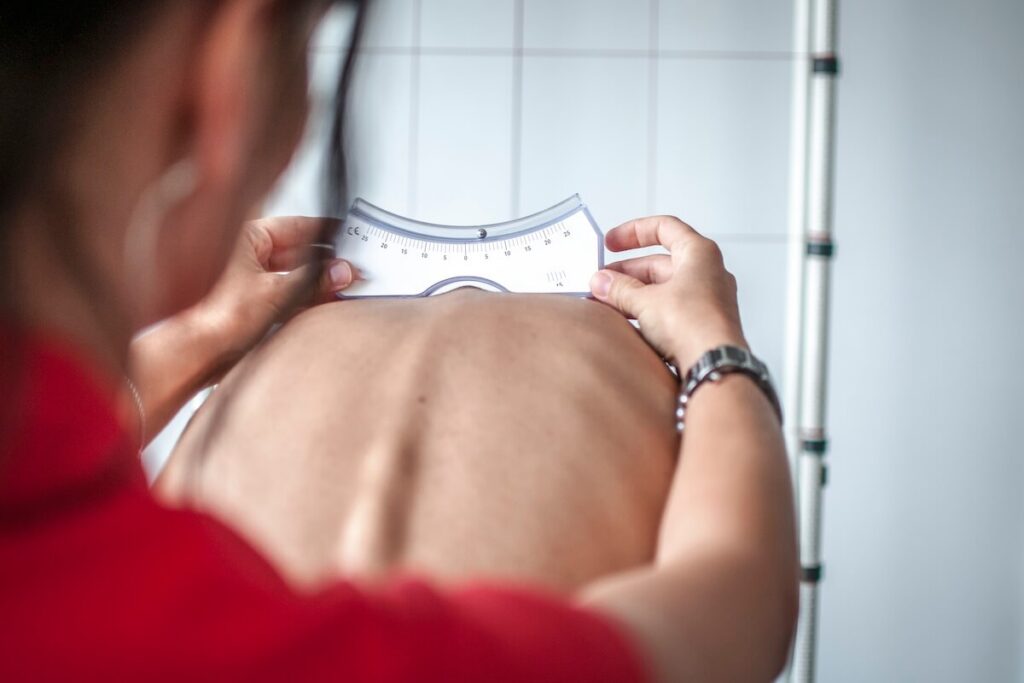
Every scoliosis case is different, but here’s what a typical conservative care plan looks like for a teenager with a moderate curve (20–35 degrees) at The Spine & Health Center:
Weeks 1–2: Evaluation and baseline
Comprehensive assessment including posture analysis, curve measurement, and functional movement screening (SFMA). We determine the specific curve classification to build a tailored Schroth program.
Weeks 2–8: Intensive Schroth sessions
Weekly or bi-weekly Schroth sessions focused on learning corrective postures, rotational angular breathing, and curve-specific exercises. Chiropractic adjustments complement these sessions to maintain spinal mobility.
Weeks 8–16: Building independence
Sessions taper as the patient gains confidence with their home exercise program. The focus shifts to integrating corrections into daily activities — sitting at a desk, carrying a backpack, playing sports.
Ongoing: Maintenance and monitoring
Re-evaluations every 3–4 months to track progress, adjust the exercise program, and coordinate with the patient’s orthopedist. Home exercises become a lifelong habit to maintain postural correction.
If bracing is part of the plan, Schroth-specific breathing exercises also complement the brace — patients learn to breathe effectively within the brace, which can improve comfort and compliance.
Adult scoliosis: it’s not too late for conservative care
Scoliosis isn’t just a childhood condition. Adults can develop new curves as the spine degenerates with age (degenerative scoliosis), or see a curve that was stable for decades begin to progress. Symptoms like increasing back stiffness, uneven posture, and chronic pain often bring adults back to the conversation about their spine for the first time in years.
The goals of adult scoliosis treatment differ from adolescent care. While a teenager’s program focuses heavily on halting progression during growth, adult programs center on:
- Pain reduction through improved postural alignment and muscle balance
- Functional improvement — being able to walk, exercise, and move through daily life without limitation
- Halting further progression that occurs with spinal degeneration
- Avoiding surgery when possible through consistent conservative management
The Schroth Method has shown benefits for adults as well as adolescents, and sessions are typically shorter — 4 to 8 visits to learn a home program, with periodic check-ins. Combined with chiropractic care for mobility, physical therapy for core strengthening, and modalities like Class IV laser therapy for pain management, adults have more options than they may realize.
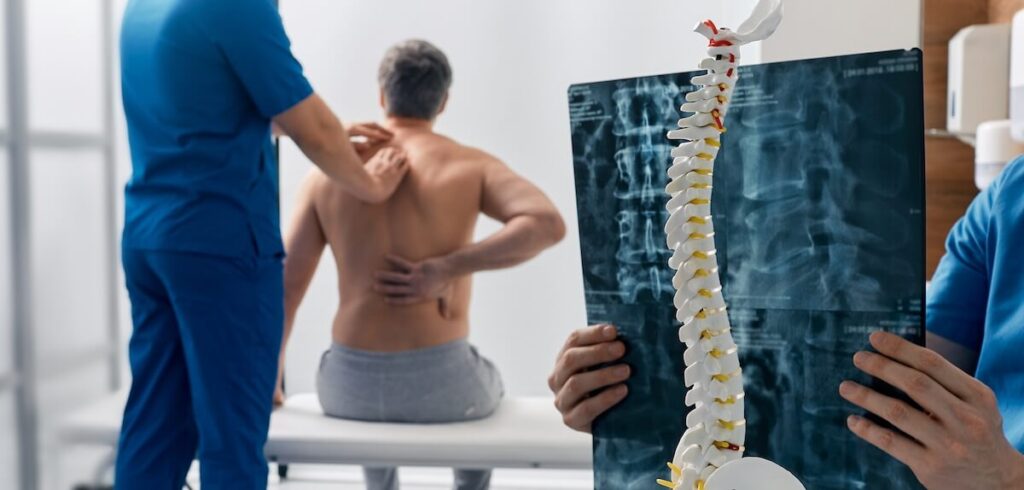
When bracing or surgery is the right call
Conservative care is powerful, but it’s not the right answer for every patient. It’s important to be transparent about when other interventions are needed:
Bracing is typically recommended for growing adolescents with curves between 25 and 40 degrees. A well-fitted brace works by applying external pressure to prevent curve progression during the remaining growth period. Schroth exercises and bracing work together extremely well — the exercises help patients breathe and move effectively within the brace while actively working the corrective muscles.
Surgery (usually spinal fusion) is generally considered when a curve exceeds 40–50 degrees in a growing adolescent or when a curve is causing significant pain, functional limitation, or cardiopulmonary issues in an adult. If surgery is the right path, post-operative rehabilitation becomes critical — and that’s another area where our team supports patients through recovery.
The bottom line: Bracing and surgery aren’t failures — they’re tools. The goal of conservative care is to give patients every opportunity to manage their curve without surgery, and to strengthen the body’s ability to support itself regardless of which path treatment takes.
Frequently Asked Questions
What age should my child start Schroth therapy?
Is the Schroth Method covered by insurance?
In most cases, Schroth therapy is billed as physical therapy and is covered by major insurance plans. At The Spine & Health Center, we work with a wide range of insurance providers and can verify your coverage before starting treatment.
How long before we see results?
Can chiropractic adjustments make scoliosis worse?
My child is already in a brace. Can they still benefit from Schroth?
Do you treat both pediatric and adult scoliosis?
Yes. Our team treats scoliosis patients of all ages. For children and teens, we also offer pediatric physical therapy and pediatric chiropractic care as part of a coordinated approach.
Take the first step toward proactive scoliosis care
Whether you’re navigating a new diagnosis or managing a long-standing curve, our Bergen County team is here to build a plan around your spine — not around a one-size-fits-all protocol.
- Closter: 31 Vervalen St, Closter, NJ 07624
- Park Ridge: 146 Kinderkamack Rd, Park Ridge, NJ 07656
- Montvale: 32 Philips Pkwy, Montvale, NJ 07645
Disclaimer: This blog post is for informational purposes only and does not constitute medical advice. Scoliosis treatment should be guided by a qualified healthcare professional who can evaluate your individual condition. If you suspect scoliosis, schedule a comprehensive evaluation with a specialist.