

In this sciatica treatment guide:
- What is sciatica — and what’s actually happening?
- Sciatica symptoms: how to know it’s your sciatic nerve
- What causes sciatica?
- The sciatica treatment roadmap (least to most invasive)
- Chiropractic care for sciatica
- Physical therapy for sciatica
- Advanced modalities that accelerate recovery
- What sciatica recovery actually looks like
- When to worry: red flags that need immediate attention
- Frequently asked questions
If you’ve ever felt shooting pain travel from your lower back down through your leg, you already know how debilitating sciatica can be — and you’ve probably searched for sciatica treatment options that actually work. However, most online guides give you a bullet-point list of stretches and send you on your way. Consequently, patients are left guessing which approach is right for their specific situation.
This guide is different. We’re going to walk you through exactly what’s happening inside your body, present every conservative treatment option in order from least to most invasive, show you realistic recovery timelines, and tell you when it’s time to seek emergency care. At The Spine & Health Center of New Jersey, we treat sciatica daily across our Closter, Park Ridge, and Montvale offices using a coordinated chiropractic and physical therapy approach — so this roadmap reflects what actually works in clinical practice.
What is sciatica — and what's actually happening in your body?
Sciatica is not a diagnosis itself. Instead, it’s a symptom of an underlying problem compressing or irritating the sciatic nerve. Specifically, the sciatic nerve is the longest and thickest nerve in the human body, running from the lower lumbar spine through the buttock and down each leg. According to the National Institute of Neurological Disorders and Stroke (NINDS), sciatica affects up to 40% of people at some point in their lives.
When something presses against this nerve — a bulging disc, a bone spur, or an inflamed muscle — it sends pain signals along the entire nerve pathway. As a result, you might feel pain in your lower back, buttock, thigh, calf, or even your foot, depending on where the compression occurs.
of people experience sciatica at some point in their lives
spinal segments where most sciatic nerve compression originates
of sciatica cases improve with conservative (non-surgical) care
Sciatica symptoms: how to know it's your sciatic nerve
Sciatica pain is distinctive, and recognizing it early leads to faster treatment. Importantly, sciatica typically affects only one side of the body. The symptoms can range from a mild ache to a sharp, burning sensation that makes standing or walking difficult.
Common sciatica symptoms include:
- Sharp or burning pain radiating from the lower back through the buttock and down the leg
- Numbness or tingling in the leg, foot, or toes
- Muscle weakness in the affected leg
- Pain that worsens when sitting, coughing, or sneezing
- A “pins and needles” sensation in the foot or calf
- Difficulty standing up from a seated position
Notably, sciatica pain that stays in the lower back without traveling down the leg is less likely to be true sciatic nerve involvement. In that case, other conditions like mechanical back pain or a muscle strain may be responsible.
What causes sciatica?
Understanding the root cause of your sciatica is essential because different causes require different treatment approaches. The Mayo Clinic identifies several primary causes, and your provider should pinpoint which one applies before starting treatment.
Herniated or bulging disc
This is the most common cause of sciatica. When the soft inner material of a spinal disc pushes through a crack in the outer shell, it can press directly on the sciatic nerve roots at L4, L5, or S1. As a result, patients often experience sudden onset pain after bending, lifting, or twisting. Our spinal decompression therapy is specifically designed to relieve disc-related nerve compression.
Spinal stenosis
Narrowing of the spinal canal puts pressure on the nerves passing through it. This condition develops gradually and is more common in patients over 50. Consequently, the pain tends to worsen with standing and walking and improves when sitting or leaning forward.
Piriformis syndrome
The piriformis muscle sits deep in the buttock, and the sciatic nerve runs directly beneath it — or in some people, through it. When this muscle spasms or tightens, it can compress the nerve and mimic the symptoms of lumbar sciatica. Specifically, Active Release Technique (ART) and fascial manipulation are effective treatments for this type of nerve compression.
Degenerative disc disease
As discs lose hydration and height over time, the space between vertebrae narrows. This can lead to bone-on-bone contact, bone spur formation, and nerve compression. Although degenerative changes are a normal part of aging, they don’t have to cause pain if the surrounding structures are properly supported.
Spondylolisthesis
When one vertebra slips forward over the one below it, it can narrow the opening where the sciatic nerve exits the spine. In particular, this condition is common in athletes and individuals with repetitive lumbar extension activities.

The sciatica treatment roadmap: least to most invasive
Here’s what most sciatica guides won’t tell you: there is a clear, evidence-based order to treating sciatica, and surgery is the last step — not the first. The American Physical Therapy Association (APTA) and the American Chiropractic Association (ACA) both emphasize conservative care as the frontline approach. Here is the progression we follow at The Spine & Health Center.
-
Self-care and activity modification (Days 1–7) Avoid prolonged sitting and bed rest. Apply ice for 20 minutes several times daily during the first 48 hours, then alternate with heat. Gentle walking keeps blood flowing and prevents stiffness. Over-the-counter anti-inflammatories can help manage acute pain.
-
Chiropractic evaluation and spinal adjustments (Week 1–2) If self-care doesn't resolve symptoms within a week, a chiropractic evaluation identifies the structural cause. Spinal adjustments restore proper alignment and reduce nerve compression. Most patients feel measurable improvement within 2–4 visits.
-
Physical therapy and targeted exercise (Weeks 2–8) Physical therapy strengthens the core, hip, and gluteal muscles that support the lumbar spine. Your PT designs a progressive program that addresses your specific movement deficits and prevents recurrence.
-
Advanced modalities (Weeks 2–12, as needed) Class IV laser therapy, spinal decompression, acupuncture, and shockwave therapy are layered in when core treatment alone isn't progressing fast enough.
-
Epidural steroid injections (if conservative care plateaus) When 6–8 weeks of conservative treatment provides only partial relief, a pain management specialist may recommend a corticosteroid injection to reduce inflammation around the nerve root. This is a bridge — not a standalone solution.
-
Surgical consultation (last resort) Surgery is considered only when conservative care fails after 3–6 months, or when progressive neurological deficits develop. Procedures like microdiscectomy have high success rates for appropriate candidates. Our team can guide you through post-operative recovery if surgery becomes necessary.
Chiropractic sciatica treatment
Chiropractic adjustments are one of the most effective frontline treatments for sciatica because they address the mechanical cause of nerve compression rather than just managing symptoms. A systematic review in the JAMA Network found that spinal manipulation produces significant improvements in acute low back pain.
At The Spine & Health Center, our chiropractors use a combination of techniques tailored to your specific diagnosis:
- Spinal adjustments — restore proper alignment at the segments compressing the sciatic nerve
- Active Release Technique (ART) — breaks up adhesions in muscles like the piriformis that may be compressing the nerve
- Graston Technique — instrument-assisted soft tissue mobilization to release tight fascia along the nerve pathway
- FAKTR — functional movement combined with soft tissue treatment for active patients
- Trigenics — neurological muscle assessment and treatment for persistent nerve-related weakness
Importantly, chiropractic care doesn’t just “crack your back.” As we explain in Chiropractors Aren’t Just Back Doctors — We’re Root-Cause Doctors, the goal is always to identify and correct the underlying structural problem driving your sciatica.
Physical therapy for sciatica treatment
While chiropractic care restores proper alignment, physical therapy builds the muscular support system that keeps that alignment in place. Research in the Annals of Internal Medicine (via NIH) shows that early physical therapy intervention leads to lower overall healthcare costs and better long-term outcomes for sciatica.
Your sciatica treatment PT program
Your physical therapist begins with a comprehensive movement assessment — often using the SFMA (Selective Functional Movement Assessment) — to identify exactly which movement patterns are contributing to your nerve irritation. From there, your individualized program typically includes:
- Nerve gliding exercises — gently mobilize the sciatic nerve to reduce adhesions and improve its ability to slide through surrounding tissues
- Core stabilization — strengthen the deep stabilizers (transversus abdominis, multifidus) that protect the lumbar spine
- Hip and gluteal strengthening — weak glutes force the lumbar spine to compensate, increasing disc pressure
- Flexibility training — targeted hamstring and piriformis stretches reduce tension on the nerve pathway
- Postural correction — particularly important for patients with desk job-related sciatica
Additionally, our physical therapists may incorporate blood flow restriction (BFR) therapy to accelerate strength gains without placing heavy loads on the spine.
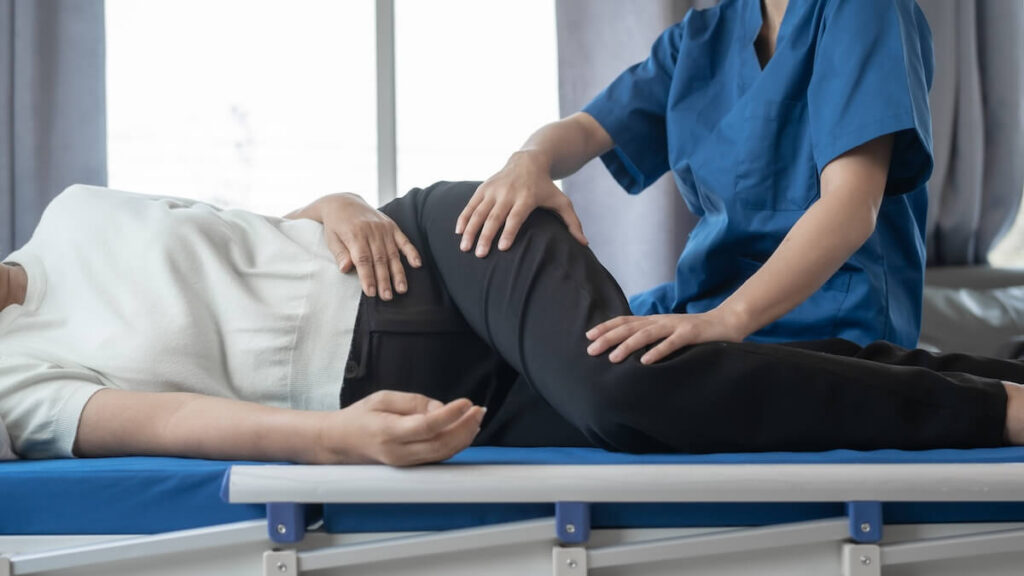
Advanced modalities that accelerate sciatica treatment
Beyond core chiropractic adjustments and physical therapy exercises, our team integrates advanced modalities at strategic points during your recovery. These are not standalone treatments — they work best when combined with the foundational care described above.
Deep tissue photobiomodulation that reduces inflammation around the sciatic nerve, accelerates cellular repair, and provides measurable pain reduction. Particularly effective during the acute phase.
Mechanical traction that gently separates vertebrae, creating negative pressure that draws herniated disc material away from the nerve. This modality is specifically designed for disc-related sciatica.
Stimulates natural endorphin release, reduces muscle spasm along the nerve pathway, and addresses the stress and anxiety that often accompany chronic sciatic pain.
Acoustic wave technology that promotes blood flow and tissue regeneration in chronically tight muscles — especially useful for piriformis syndrome and chronic gluteal tension.
Decompresses soft tissue layers and increases local circulation along the gluteal and hamstring regions where sciatic nerve tension is greatest.
What sciatica recovery actually looks like
One of the biggest frustrations for sciatica patients is not knowing what to expect. Here is a realistic recovery timeline based on the combined chiropractic and physical therapy approach we use at The Spine & Health Center.
| Timeframe | What to expect | Treatment focus |
|---|---|---|
| Week 1–2 | Acute pain begins to decrease; sitting tolerance improves | Chiropractic adjustments, ice/heat, gentle movement |
| Week 3–4 | Pain centralizes (moves from leg back toward spine — a good sign) | Add physical therapy exercises; begin core activation |
| Week 5–8 | Significant pain reduction; strength and mobility noticeably improve | Progressive strengthening; advanced modalities as needed |
| Month 3–4 | Most patients return to full daily activities and exercise | Sport-specific or activity-specific rehab; maintenance adjustments |
| Month 6+ | Long-term maintenance; preventing recurrence | Home exercise program; periodic chiropractic check-ups |
Pain centralization is progress: If your leg pain starts moving upward — from the calf back to the thigh, or from the thigh to the buttock — that typically means the nerve is decompressing. This is a positive sign, even if the back pain temporarily increases.
When to worry: red flags that need immediate attention
Most sciatica responds well to conservative treatment. However, certain symptoms require emergency medical evaluation because they may indicate a serious condition called cauda equina syndrome, which can cause permanent nerve damage if not treated within hours.
Seek emergency care immediately if you experience:
- Sudden loss of bladder or bowel control
- Numbness in the “saddle area” (inner thighs, groin, buttocks)
- Progressive weakness in both legs
- Severe, rapidly worsening pain that doesn’t respond to any position change
These symptoms are rare, but they require immediate evaluation. If you’re unsure, call our office at (201) 746-6577 and we’ll help you determine the right next step.
Additionally, you should contact your provider — rather than continuing to self-treat — if your sciatica is accompanied by fever, unexplained weight loss, or a history of cancer. These symptoms may warrant imaging to rule out other conditions.
Frequently asked questions about sciatica treatment
How long does sciatica treatment take?
Most acute episodes improve significantly within 4 to 6 weeks of conservative treatment. However, chronic sciatica caused by structural issues like herniated discs or spinal stenosis may require 3 to 6 months of coordinated chiropractic and physical therapy care. Consistency with your treatment plan and home exercises makes the biggest difference.
Can a chiropractor help with sciatica treatment?
Yes. Chiropractors treat sciatica by correcting spinal misalignments and joint restrictions that compress the sciatic nerve. Research published in the JAMA Network supports spinal manipulation for low back pain. At The Spine & Health Center, chiropractic care is combined with physical therapy for the most complete and lasting relief.
Is walking good for sciatica?
Gentle walking is generally recommended because it promotes blood flow, prevents stiffness, and encourages natural nerve gliding. However, walking through sharp or worsening pain is not advised. A physical therapist can help determine the right intensity and duration for your specific condition.
What is the best sleeping position for sciatica?
Sleeping on your back with a pillow under your knees reduces pressure on the sciatic nerve. If you prefer side sleeping, place a pillow between your knees to keep your spine aligned. Avoid sleeping on your stomach, which increases lumbar extension and can aggravate nerve compression.
When should I go to the ER for sciatica?
Seek emergency care if you experience sudden loss of bladder or bowel control, progressive weakness in both legs, or numbness in the saddle area (inner thighs and groin). These symptoms may indicate cauda equina syndrome, which requires immediate medical intervention.
Does sciatica go away on its own?
Mild sciatica can resolve within a few weeks. However, sciatica caused by a herniated disc, spinal stenosis, or degenerative changes is more likely to recur without professional treatment. Conservative care from a chiropractor and physical therapist addresses the root cause and significantly reduces the chance of future flare-ups.
Can sciatica cause knee pain?
Yes. The sciatic nerve branches into smaller nerves that serve the knee area. Compression at the lumbar spine can refer pain, tingling, or weakness into the knee. In fact, many patients are surprised to learn that their knee pain originates in the lower back.
What is the fastest sciatica treatment?
The fastest path to relief combines chiropractic adjustments to restore spinal alignment with physical therapy exercises to stabilize the core and reduce nerve irritation. Adding modalities like Class IV laser therapy or spinal decompression can further accelerate healing.
Sciatica pain doesn't have to control your life. Let's find the cause and fix it.
Our Bergen County team will evaluate your sciatica, identify the root cause, and build a coordinated treatment plan — chiropractic care, physical therapy, and advanced modalities — tailored to get you moving again.
- Closter: 31 Vervalen St, Closter, NJ 07624
- Park Ridge: 146 Kinderkamack Rd, Park Ridge, NJ 07656
- Montvale: 32 Philips Pkwy, Montvale, NJ 07645
Disclaimer: This blog post is for informational purposes only and does not constitute medical advice. If you are experiencing sciatica symptoms, consult a qualified healthcare professional for a personalized evaluation. In cases of sudden loss of bladder or bowel control, progressive leg weakness, or saddle-area numbness, seek emergency medical care immediately.